Powered By Blogger

Thursday, 16 February 2012

The Playstation Vita: An Honest Opinion (Of the Hardware)

Well, guess what? It’s February 16th. We’re now less than a week away from the North American launch of Sony’s new handheld, the Playstation Vita. Or, if you were one of those extremely excited gamers, you pre-ordered the First Edition Bundle, and received it yesterday. Yeah, that’s right, I now have a Vita. And I’ll be looking it over extensively, letting you know whether or not it’s worth a buy. I’ll be going over the system itself today in a bit of a hardware review (to the degree that I can). Tomorrow, I’ll post one about the system software: what comes preinstalled on the Vita, the services it offers, what it all does, and how well it all works. Then I’ll be giving reviews of the four titles I have for the system. And, hopefully by Tuesday, I’ll post a final overlook, stating outright whether or not I think this thing is a buy, so that you can take my opinion into account, along with all the others you’ll hear. Keep it mind, it’s new. There’s that ‘new hardware’ honeymoon period to get through, so I may rave about it at first, and then outright change my mind by Tuesday. Don’t call me inconsistent if that should happen, just label me as ‘starry-eyed, and now paying for it.’


A couple of things  before I dive in. First, I want to make it clear that I saw the Vita reveal at E3 2011, and I was instantly intrigued. It was the most impressive looking handheld I’d ever seen, and given the tech that was involved, the price point wasn’t too bad at all. The non-optional memory card soured my opinion a little bit, but I was still so impressed with the way the system looked that I was willing to look past that. When the full launch (and launch-window) software line-up was revealed, I was stunned. It was the most impressive line-up I could ever recall. This thing has more titles at launch than I think the PS3 or 360 did during their first year on the market. I may be exaggerating, but it was, and is, impressive, nonetheless.


On the flipside of that, as the release date neared, (this one, not the original assumed December date), I started to get extremely peeved at the way it was covered. No matter who it was that got their hands on the system, all they could talk about was how sturdy it felt, how comfortable it managed to be, despite it’s size and the potentially problematic layout. They were all about the aesthetics. But to my mind, when your average consumer, (like, say, me), forks out $300 for a handheld console, aesthetics aren’t the only thing you’re thinking about. Sure, the screen may look good, but are the controls tight? Does the touch screen work as it should? Does the rear touch-pad actually integrate comfortably into gameplay? I wanted to know all that stuff, and aside from a few vague mentions, I wasn’t getting it. Nevertheless, (and I can’t explain why), I completely trusted in Sony. They’ve stumbled before, quite severely, in some cases, and the PSP never seemed to live up to the expectations they had for it. But I was willing to believe that the Vita would succeed. So much so, I wanted to get my hands on it a week early. Was my optimism warranted?


Well, I have to start off by admitting, (rather grudgingly, it’s true), that the Vita is a sturdy piece of tech. There is a sense that you could drop it, and it wouldn’t instantly shatter into a million pieces. Not that I want to test that, or anything. The odd thing, though, is that I don’t think it feels quite as sturdy as the DS does. Maybe it’s the lack of a close-over screen, but while it feels strong in its own right, it seems inherently more fragile than a DS. Then again, the DS, like all of Nintendo’s handhelds, is designed for younger gamers. They have sturdiness down to an art form. The Gamecube was nothing if not an indestructible lunchbox, and the DS followed that closely and comfortably. I’ll admit, I didn’t spend that much time with the PSP, but from what I can recall, the Vita definitely feels stronger than it’s predecessor.


It’s comfortable, too. Now, I’m a man. I have man-sized hands, and the DS always felt a little small. My fingers would start to hurt if I spent too much time with the DS. That said, I didn’t grow up playing all of Nintendo’s handhelds. It’s possible that if I had a Gameboy growing up, I would have gotten used to playing with such a cramped d-pad and face buttons. Nevertheless, for me, the Vita feels instantly more comfortable. While it’s larger than your average controller, there is very little difference in the feel of holding the two, though I will say the first time I powered it up, it did feel a little awkward. I think it has something to do with the rear touchpad: there are two divots on the back that your fingers can curl into so that they’re not touching it, but the first time, it feels just the slightest bit wrong. The adjustment to that is very quick, though. I’ve been toying around with it since yeterday, and gripping it no longer feels even the slightest bit weird.


And the screen. Oh, that screen. The first time you turn on the Vita, there’s this little intro cinematic thing, and though it’s kind of mundane, it looks good. Great, in fact. That a handheld console is capable of equalling, if not outright surpassing, in some cases, the graphical capabilities of the big consoles is nothing short of astounding, to my mind. And, of course, it looks out and out better than the graphics on the Wii. I’m baiting, of course, but my point stands: that 5-inch OLED screen looks so good that making it a touch screen almost seems like a crime. It’s not even just the screen: the entire system is sleek and sexy looking. I probably shouldn’t say that about a machine, but it’s true. From an aesthetics standpoint, it has it all.
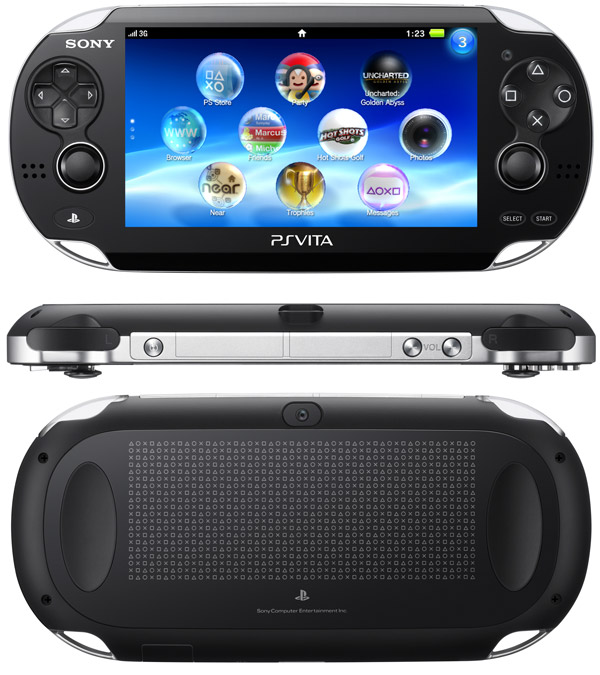

Above: the lovechild of a DS and a PSP. The parental rights all went to Sony, though.


So, good point, good point, good point: study, comfortable, and pretty. Now let’s hit a low. Those (insert string of curse words here) memory cards. The price of the bloody things. I actually can’t spend a lot of time on this, or I’ll have an aneurysm. Why the hell Sony couldn’t have just used SD cards, I have no clue. Like, an 8GB PS Vita memory card costs $30. Now, $30 isn’t a whole lot in itself, but when you consider that an 8GB SD card doesn’t even cost 10 freakin’ dollars, it’s absolutely ridiculous! A 32 GB PSV card is $100. $100! Highway freaking robbery!  Honestly, if I spend a moment being rational, I come to the conclusion that there’s so much tech in the Vita that at the price they’re selling it at ,Sony isn’t making much of a profit, (I know there was a breakdown done, but I don’t remember exactly what the numbers were), and these memory cards are their way of recouping, but it’s still absolutely, completely asinine. This alone is enough to turn away a lot of potential buyers. My First Edition Bundle came with a 4 GB memory card, but that’s going to run out extremely quickly. I have to move on. I can feel my arteries clogging already.


Now, I know that I could stop now, having technically described the hardware. I would also be the biggest hypocrite in existence, having just spouted pretty much the exact same things that every other internet personality has already said. So now, I’m going to explain how well (or poorly) the touch features work.


First, for the rear touchpad. It works. It feels kind of nice, as well. It’s almost better to use than the main touch screen, because it doesn’t smudge quite so bad. That said, just like actually holding the Vita, I found that the rear touchpad had a little bit of an adjustment period. It’s just the slightest bit difficult to gauge where your touch on the rear screen is going to register in a game at first, but once you get going, it becomes pretty easy to judge. That said, I don’t know how easy it would be to implement in an action-oriented game. Puzzle games and mini-game collections are one thing, but in a game where you need might need split-second reaction, you might be hard-pressed to be able to make the rear touchpad work the way you want it. But, so long as no developer tries to cram that in, I don’t think it’ll be a problem, and as it stands, the rear screen works as it should, and I find that it serves quite well.


The front screen, as I said, is so pretty that it’s almost criminal to make it serve as a touch screen as well. But that’s exactly what Sony did. Touch screens are fairly common now, but there not always done well. I’ve played around with phones whose touch screens are absolutely awful. The Vita’s touch screen isn’t, though. Both single and multi-touch work incredibly smoothly, and the few other functions you’ll use, such as pinch-zoom, are nice and responsive. My only problem, and I think I mentioned this earlier, is that touch the screen inevitably smudges it. It’s not like this is a huge problem, but if you’re a gross, sticky-fingered child, you may muck up the screen to the point where you can’t clean it properly. There are protective films available, though, (2 for $10), so you can keep your screen pristine, if you so choose.


The actual layout of the buttons, sticks and d-pads was a cause of concern for me. The analog sticks are somewhat small, and I wondered if the right stick might interfere with the buttons, or vice-versa. I wasn’t sure if I would be pushing on the right stick, and my thumb would slip off and hit one of the buttons, or if I might inadvertently push the stick when trying to hit the buttons. I haven’t had any problems yet, but that doesn’t mean I won’t at some point. The d-pad is actually quite nice, better, I find, than the d-pad on the PS3 controller. I haven’t used it a whole lot, but the little that I have, I’ve enjoyed. I guess this whole ‘nice button layout’ thing is just an extension of my comfort bit, but I felt it was worth mentioning separately, since it was something I wondered about when I was seeing coverage of the Vita.


I’ll admit, I haven’t played around with the cameras too much. They’re only .5 MP, though, so I don’t think they’ll ever be anything spectacular. The ability to record video was added with a recent update, (so if you’re buying at the North American launch, it’ll already be there), but I haven’t done that yet, either. Truthfully, that was all secondary to how well the system could play the games meant for it.


I think that’s a pretty good once-over of the hardware on the thing. Overall, the Vita is sleek and comfortable: easy to hold, and completely functional in all areas that it should be. It does take the smallest amount of getting used to, but once you do, I doubt you’ll ever want to go back to a PSP, or even a DS. Sony could have done a little bit to ensure the Vita felt sturdier, but I would wager that it isn’t actually flimsy, it just feels that way for some reason. The stupid memory card thing is a HUGE negative stamp on the Vita, although from what I’ve seen, the rest of its accessories aren’t priced too badly. The big question: does the hardware alone justify the cost? Honestly: no. While it’s an impressive piece of tech, it’s (obviously) not worth owning if the games aren’t any good. So come back over the next few days, and I’ll get you my feelings on that, as well, and then one final post to tell you whether or not, in my opinion, it’s worth a buy come Wednesday.

Thursday, 9 February 2012

The Introspection Corner

Hey, legions of the internet.

So, I've started another blog that's going to run into a tangential sort of parallel with this one. To be short and sweet about it, sometimes, when playing a game, you start to feel something very specific about it. Maybe it's because you love it, maybe it's because you hate it. The thing is, these specific reactions don't always fit into your opinion of the game, but rather, exist outside of them. Parallel to them, if you see what I'm getting at. The Introspection Corner, which can be accessed through clicking that link, or the one on the sidebar, is where I'm going to be putting these deeper reactions. I figure, if I'm giving you my opinion on them, why not go the whole hog and just tell you about the feelings that are running a little deeper. Anyway, that's all I wanted to say, for now. I'll be posting a series of opinions on one very specific topic next week, so you can expect to hear more from me then. But, for now, enjoy your life!

Monday, 6 February 2012

Final Fantasy XIII-2: An Honest Opinion

Final Fantasy XIII is unarguably one of the most divisive entries in the series. There was no real middle ground with the game: you either loved it, or you hated it. Developer Square Enix took all the fan criticism to heart, and attempted to lay it to rest with the release of Final Fantasy XIII-2, which is (as far as I know), only the second direct sequel in the series, (the other being Final Fantasy X-2, which we don't talk about). So, did Square succeed in its attempts to both please the fans of XIII, and address the criticisms of those who hated it?


First off, you should know, I was one of those people that actually liked Final Fantasy XIII. I didn't get a chance to finish it, as my 360 suffered a fatal hardware malfunction, and was laid to rest, but I got pretty close to the end. In fact, I enjoyed it so much that when I went out to buy XIII-2, I actually looked for a used PS3 copy of XIII to pick up at the same time. I figured I'd bull through all of XIII before playing XIII-2, which probably would have precluded my giving XIII-2 an honest opinion here. But, I couldn't find a used copy of XIII, so, here I am with my opinion on XIII-2.


Final Fantasy XIII-2 takes place 3 years after the events of XIII. Due to some weird flux in the timeline, Lightning has ceased to exist in her own time period: her sister, Serah - who, along with newcomer Noel Kriess, are the primary story characters, - is the only one who believes Lightning is still alive. The rest of those that knew Lightning just assume she's in the crystal pillar, holding up Cocoon alongside Fang and Vanille. That is, until Noel shows up, and informs Serah that Lightning is, in fact, alive, kicking, and most definitely not crystal, in a place called Valhalla, and offers to help Serah find her.


She's also got this feather sword going on. Must be a Valhalla thing.
This is your springboard into the rest of the game. The closest analog I (or any other website on the internet that you'll look), can give you to this story is Chrono Trigger. You end up travelling to different time periods in an attempt to reach Valhalla and Lightning. Early on in the game, like Episode II early, you're introduced to the idea of paradoxes: things are happening that shouldn't be. Something's causing the timeline to shift big time, and a lot of the story is focused on righting these wrongs in order to find artifacts, which allow you to use the time gates. The problem with this is that the idea of these paradoxes is thrown around so much that they start to lose meaning. If you were exposed to three or four huge paradoxes, (like Chrono Trigger), and then left to try and solve those while the story played out, the consequences of your actions would have been a lot stronger. There's also the problem that you leave your newly established community on Pulse (that's delving into XIII's back story a little bit, so I'm not going into it) at the end of the first chapter, and through what I feel is a bit of a cop-out, warned that you might not return. I feel that the story would have had more impact if something really wrong happened in Serah's own time, adding further motivation to her journey: yes, she wants to find Lightning, but she wants to right the wrong that plagues her home, as well. The idea is toyed with at the beginning of the game, but not capitalized on. Granted, I haven't finished the game, so that may be a later plot device, but as it stands, I feel like Square Enix missed an opportunity there.


This is the closest thing to a paradox in your home time that I've found, and it can't even be bothered to crawl all the way out of its portal.
Combat was one of the things a lot of fans agreed Square did right with XIII, and for the most part, I agree. The paradigm system affords you the choice to drastically change your combat strategy on the fly. In XIII-2, it's seen a few tweaks. Shifting paradigms, for example, no longer uses any momentum, so you can literally change your paradigm while an enemy is preparing for an attack. That becomes a key strategy to quite a few of the fights you'll come across. It also helps eliminate the feeling of automation combat can sometimes have. For a lot of the fights, especially early on, you can pretty much just hit 'Auto-attack,' and let the game queue up your moves for you. If the paradigm system weren't in place, this would be rather insulting, and, as it is, there are times when combat is a little less than enjoyable for this reason. Square has also seen it fit to add 'cinematic moments' to combat. These are basically quick-time events, but I hesitate to use the term, because you're given ample time to perform most of them. I think it's just a device Square put in place to give the battles a little more theatricality, and ultimately, whether they succeeded or not will depend on the person playing. Personally, I didn't find these moments to either add or take away anything from the game. They were just there. Alongside these 'cinematic moments,' Square has added a - and I hesitate to use this analogy, because it's been made a thousand times since the game's launch a week ago - Pokemon-(shudder)-like system, whereby you can gain the ability to summon some of the monsters you fight. This adds a third member to your party, whom you can add to whatever paradigm you'd like, and level up individually. Though it has to be said, each monster only has one paradigm role: medics can only be medics, ravagers can only be ravagers, you get the picture. This makes sense, as the set role plays directly into the monster's strengths. Even so, if you really like one monster, you could conceivably use it for the entire game, and just build your paradigms around it. The thing is, this monster system is the only thing that adds any real party variety: Serah and Noel are your only two party members, (at least so far as I'm aware). This is an incredibly odd design choice for a Final Fantasy game, as usually you have a cavalcade of colourful characters to choose from. It also means that you'd better either like Noel and Serah, or feel indifferent to them. If you actively dislike them, you're going to have a hard time playing the game.


I shall call him Squishy, and he shall be mine.
Square was attempting to fix the criticisms that it received for Final Fantasy XIII, while still not alienating those who enjoyed it, and for the most part, they succeeded. There's more exploration to the world, combat has been tweaked to make it more fun, and the balls-tacular weapon upgrade system was removed, replaced instead with the old RPG standby, that being equipment you can buy. They also made some puzzling design choices, though. Dropping the party down to two characters and a monster is one. It doesn't hurt the game, exactly, but it seems to be a little out of left field. There's also the ridiculous dialogue choices. I think I discovered earlier what they're for: if you pick the 'best' choice when you're given the option, you're given items at the end of a section. I noticed that at the end of the first episode, but couldn't have told you at the time why a treasure box suddenly appeared floating next to me after a cutscene. So, if you're wondering what to do with them, try to pick the option must germane to the conversation you're having. If it turns out I'm wrong, then I give up, because they don't seem to have any ramifications on the way the story is played out at all. Oh, and there's the music. If you're a J-Pop fan, I think you'll like this game: the soundtrack is brimming with the stuff. It's sickeningly sweet and upbeat for the most part, although during boss battles, you're exposed to some odd Japanese metal music. J-Metal, I guess? Either way, the soundtrack is definitely not one of the game's strongest features.  There also seems to have been some slight change to the characterization of Serah between XIII and XIII-2. I can't quite put my finger on what it is, but she doesn't seem to be as - I don't know, tough? - as she was when she came up in XIII. Noel's interesting enough, and pretty well characterized, for the most part. You know his wants and motivations perfectly almost from the get go, but there's still a little bit of enigma surrounding him. The only thing that falls flat is his voice. I've never been a fan of the guy who does his voice (even though I can't name him). I just wonder, though, whether choosing Serah as the game's primary protagonist was a good choice. She doesn't seem as compelling a lead character as Lightning was. At least in my mind. If you disliked Lightning, then you'll actually probably like Serah. She's the antithesis of Lightning in most ways.

Seriously, though: Who looks like they'd carry the lead better?

All in all, XIII-2 is a fairly good addition to the series. It does what a sequel is supposed to do (unlike Final Fantasy X-2, which I'm actually now going to gamer's hell for mentioning twice), in that it keeps what made the original enjoyable, (for the most part), tweaks it a little to make it work better, and then fixes the weak points of its progenitor. There are a few points about the game that I didn't mention: the change to the Crystarium, which is your system of levelling up, for example, or 
the addition of Chocobolina and her crafting system, (and general ability to unnerve), and there were a few more points on the story I could have made, but I feel it's best to render my verdict now, before I start to drag on. Personally, I like Final Fantasy XIII-2. If you enjoyed XIII, you probably will as well. If you didn't enjoy XIII, it's worth a rent, at the most. The necessary changes are there, but I still don't know if Square took them quite far enough to quiet the shouts of those who truly disliked Final Fantasy XIII.


Wednesday, 1 February 2012

A Note On Screenshots

This just occurred to me after I posted my opinion on Heroes, but it seems fairly important. Not all the screenshots you'll see here are taken by me personally. Some, (most of them, really), are, but the rest are taken from elsewhere. This will be especially true if I'm giving my opinion on a console title, as I don't really know how to take a screenshot of a console game properly. If I've taken them from other websites, the caption beneath them will be a link to the website I got them from. Consider it an embedded image. Anyway, just thought you should know. All images are properties of their respective owners and all that jazz, eh wot?

Might and Magic: Heroes VI: An Honest Opinion

So, in my anticipation of all the big stuff releasing over the next little while: Final Fantasy XIII-2 and Soul Calibur V dropped yesterday, Kingdoms of Amalur next Tuesday, (February 7th, if you're keeping track), the Vita launch - you know, the big stuff - I decided to fill the time by playing smaller games. One of these smaller games happened to be Might and Magic: Heroes VI, a turn-based strategy game developed by Black Hole entertainment, that I downloaded off Steam. Now, like The Binding of Isaac, Heroes VI has been out for a while, but given my fixation on triple-A titles, it's not something I was really paying attention to when it came out. In fact, I'll tell you a secret: I've never played a Might and Magic game before. Yes, I've heard of them, but never actually delved into them. Here's another secret: I don't play a lot of turn-based strategy games. That makes this game a really odd choice for me to download, I know, but the reviews about it were mostly favourable, so I decided it might be worth giving it a whirl. And a whirl I gave it.


Since I was going into this series blind, the first thing I was curious about was how the game's story would play out. Was it a direct continuation of Heroes V, whose story I wouldn't understand because I'd never played its progenitor? Well, I can't say for sure. You see, since I'd never played a Might and Magic game before, I decided to judge the game's story based on itself, instead of how it fit into the wider lore of the series. That meant not looking up what had happened in the previous games, and simply playing this one. Now, at the time, that seemed a perfectly fine idea. What I didn't realize, though, was how much I was going to dislike the way the story is presented. There are elements of the story that are presented through cinematics: the opening, pre-menu cinematic was actually pretty cool, but there are other story elements that are presented in flat dialogue sections that simply feature a box of text and character portraits superimposed over the map you're about to play on. To me, that simply isn't good story telling. If the entire game was like that, it would be tolerable. Fancy cinematics aren't always needed to tell a good story. But the fact that they have some cinematics makes the text box thing additionally jarring. Couple that with the fact that the voice-acting in the game is somewhat flat, and it just doesn't make for an engaging tale. The content of the story could make for a very interesting game; something about a soul trapped in a sword, a war, archangels flying around trying to make everything right again, people dying, and what have you. But, again, it just wasn't presented in a way that managed to hook me, and I actually only have a very limited idea of what was going on while I was playing. And no, I didn't make it all the way through. There are several different campaigns to play through, and while that would probably be something fans of the series or turn-based strategy games would be fairly happy about, for me, it just meant there were parts of the game I wasn't going to see.


Above: A rearing horse upset with its lack of screen time.


What about the gameplay that supports this story that I wasn't really engaged by? Well, it's pretty standard turn-based strategy fare, from what I was able to tell. You start on a world map with a hero army and (sometimes), a friendly city, and then you proceed to build up your armies while exploring the world map, looking for enemy settlements, friendly units to recruit, resources to collect, etc., etc. It's all very top-downy, as anyone who has played a turn-based strategy game would expect, and anyone who hasn't could see by looking at screenshots. I think it's here that my biggest problem with the genre is: I just don't find this a particularly engaging mechanic of gameplay. If they were to ax that system, and opt for a more Final Fantasy Tactics-y system, I think I would have enjoyed the game a lot more. That doesn't actually make any sense to me, since real-time strategy games use a similar method, but I enjoy them a lot more than TBS games. Don't ask me why, I don't know. There's enough similarities between the two genres that enjoying one should, (in theory), equal at least a limited enjoyment of the other, but I found Heroes VI just too ... dense. There's a lot to be conscious of. You've got your hero's level, which directly affects the strength of the troops in his army, but not your other friendly armies, resources to watch, cities to manage, and a world map to navigate, and all this has to be dealt this before you even get to the meat of the game, which is, of course, the battles.


Here, go explore with your aforementioned neglected horse... I'm sure that's just a bit awkward.
Here, go explore with your aforementioned neglected horse. I'm sure that's just a bit awkward...
But then, you finally get to fight things, and like the world exploration, it's a fairly familiar system, even to someone with only limited exposure to TBS games in the past, like me. Your troops line up against the enemies troops, your hero stands at the back of the line, unable to move, but with some abilities to help in combat nonetheless, and you proceed to... well, be strategical. Enemies retaliate if you attack them with a melee unit and don't kill them, your ranged units can't move and attack in the same turn (at least not that I found), and your hero can only preform their actions before any of the other troops on your side. So the idea, I assume, is that you have to think about the conflicts you're in before you start moving around and hitting things, like a sort of chess match. The thing is, I found the game to be fairly lacking in the 'need strategy to advance' department. Yes, I admitted that I didn't get very far into the game, but the bit I did play, I got by just by shooting things with my crossbow units, and then running up and wailing on them with my sentry units, occasionally using a priest(ess?) to do a little healing, and make sure they didn't get clawed apart by the demons that they were fighting. Fairly limited, strategy-wise. Yes, it's perfectly acceptable for the game to get truly difficult later on, but give me some hint at the start as to where it's headed. Even at the start of the game, I shouldn't be able to win every battle using the TBS equivalent of the 'mash the confirm button in a turn-based RPG,' system of play. I can only assume that, with five different campaigns to progress through, the difficulty curve is fairly lax. Maybe the game gets really difficult as you near the end, but I don't want to play for 12 hours just to encounter a challenge. It doesn't have to be there from the get-go, but some indication of it should be there from the opening moment.


You can figure out the unit types by yourself. I gave up on that, too.
Altogether, although this 'honest opinion' may seem silly to some, that's really my entire experience with the game: a short run followed by a dismissive hand wave and a seat on the sidelines. Overall, I just wasn't having any fun with it, and that is the only reason to keep playing a game. I've read some 'professional' reviews that praise the changes Might and Magic: Heroes VI made to the series' mechanics, and how it's a fairly robust TBS game, but since I'm not a fan of the series, nor a connoisseur of the genre, neither of these things mean diddly to me. If you're a fan of the series, or of TBS games in general, I suppose that's enough for me to tell you to at least give it a try. But if you're not a fan of either the game or the genre, and just think it looks interesting, I'd say pass on it. If you're looking for an entry-point into the genre, I'd recommend looking around some more. There has to be a TBS game out there that would be a better starting point. That's my honest opinion, anyway.

Friday, 20 January 2012

Star Wars: The Old Republic: An Honest First Impression

So, here it is: the the long-awaited tolling of the bell announcing the end of a ridiculously long school day. Doctors Ray and Greg have finally seen it fit to release Bioware's massively anticipated online role-playing game, Star Wars: The Old Republic on the PC. It now fits neatly into the library of their titles that included such critically acclaimed hits as Mass Effect, Dragon Age: Origins, and, of course, Star Wars: Knights of the Old Republic. Of course, some long time PC gamers would scoff at that list, and say we gamers of lesser (read: 'dirty') birth are stupid, and should be thinking about Bioware games like Baldur's Gate, or (in case that's way too old for you), the slightly more recent Jade Empire. But if I have to give you a run-through of Bioware's extensive repertoire, then perhaps your in the wrong place. What's important is this: The Old Republic has finally gone live.


Now, obviously, it's been live for close to a month, or a little longer, if you're counting the early access. But, as I've said before, I'm simply one man, so I can't buy every big game the moment it hits the shelves. But, since tomorrow is my birthday, (you can send presents whenever you feel like it), I decided earlier in the week to splurge a little, and purchase this hugely anticipated title. Now, being one man, there is no way I could have possibly played enough of the game yet to write a proper review, so I'm not even going to try. No, what I'm doing tonight is giving you my honest first impression of the game so far. That means what's coming here is just what I've been able to glean from the game so far: there will be no screenshots, no opinions on graphical fidelity, user-interface, combat, or any of those other review-y points. I'll be back in a few months time to write a proper review for it, which will include all those thing, but for now, you'll just have to make do with the thoughts I've had about the game so far.


Firstly, I bought the game last Saturday. The front of the case clearly states the following: "Valid credit card or paid game card (if available), internet connection and paid subscription required to play game. 30-day subscription included with purchase." Which, in my head, translated into the following: "I have 30 days to try the game before I start paying for play time. If I don't like it, I may be out $60, but that's no different than with any other game." Not so. As it turns out, you can't play at all until you've either given them a credit card number, or bought a time card, even though your account has 30 days of play time on it from the get-go. After getting the game home, installing it, and coming to this realization, I thought: "that's a bit different. They made it sound like I had 30 days to play before I gave them more money, didn't they...?" I went back and read the blurb on the case a few more times, but the wording still didn't scream "we want another $14.99 before you can play!" But I figured, "Whatever. Must have been having a slow moment." Now, I'm not in possession of a credit card, so I decided I'd go out the next day, and buy a time card. Boy, was I wrong. Every store in my area was sold out of the bloody things, and none had any idea when a new shipment would be in. I slightly agitated, (to sugarcoat it), but I didn't blame the game: I blamed myself for misreading the package and not realizing I need to pay to play, and the stores for not having any time cards. I also blamed Bioware a little bit, for not allowing prepaid credit cards to make a subscription to the game. That one I found out by reading the forums, not buying a prepaid credit card. I was thinking ahead that time.


I won't regale you with anymore of my woe: suffice to say, it was Tuesday when I finally went out, bought a prepaid credit card, and used that to purchase a digital time code from the EA Origin store. By that point, I was feeling a bit of ill will toward the game, but it was just as much my fault as the game's, so I let it be. So, Tuesday evening, when I was done all my classes for the day, I finally booted up The Old Republic, which is all I'd wanted to do since Saturday, and had my first moments with the game.


My first character was aligned with the Republic, a human female Jedi Knight, who's advanced class would eventually become Guardian. I chose Republic because I always play light-side first when a game gives me the choice, and female because I felt that female representation in the Jedi Order was very slim in the movies. I was human because, to be perfectly honest, the choice of races felt a little thin. I chose Jedi because, come on, who didn't want to use a lightsaber when they were a kid?


So, my Jedi Knight created, I proceeded to start running around Tython, ancient homeworld of the Jedi (if the game is to be believed). After about an hour of playing, I noticed something very odd: my framerate dropped drastically. It went from a smooth 50-60 fps (that's frames-per-second for those who don't know), to a choppy and almost unbearable 5.5 - 6. "Odd," I thought. "The graphical settings aren't that high, are they?" Turns out, they were. Whether it was my computer automatically setting them to the highest setting, (which, technically, it can't handle. It's a laptop, and it's getting old. Shut up.), or the game's default is simply the highest setting, I don't know. But I dropped them into the mid-range, which my computer should have been able to handle more than easily. I mean, if I can run the Witcher 2 on middle-low settings, this shouldn't be a problem, right? As it turns out, that was still no help. The framerate didn't improve. I pondered over that for a while, wondering if my internet connection was the problem, but it was running at a full 5 bars, according to the game, and I'd never had a problem with any other online game before, except for minor lag on a bad day. So, I dropped the settings down as low as they could go. No help. Well, I really wanted to play, so I shrugged off the problem, and continued to run around. The game would go from about 6 fps for a stretch of five or six minutes back up to 20 fps for about two or three, and then drop again. It was jarring, but I powered through it. After reaching level 5, I stopped for the night.


The next day, I resumed playing. I was in my basement, then, sitting pretty much right next to my router. My connection would never be stronger than that. Again, as soon as I loaded the game up, it ran fine. About a half-hour later, the slowdown started again. But, like the night before, I ignored it, and powered my way through. I hit level 8, and stopped.


This slowdown problem never really away, and it was hampering my enjoyment of the game. So, I went on to The Old Republic forums, to see if there was anyone else having a similar problem. As it turned out, there was. A whole slew of people were experiencing framerate issues, some with rigs that should have been able to run the game at double its highest settings. With no official response from Bioware, other than that they were aware of the problem, and looking into it, people were starting to get annoyed.


Last night, I played again. When I reached level 11, I left Tython, and reached the Republic Fleet. From there, my mission took me to Coruscant. I stopped shortly after getting onto the fleet, though. I just couldn't put up with the framerate anymore. Tonight, I went to Coruscant, and managed to get through a few missions before the problem cropped up again. To be thorough, I shut down my computer for a while, and when I rebooted, I started another character (a Sith warrior this time. I really like beating people with lightsabers, okay?), on a different server, lightly populated and located on the east coast (my first character was on a west coast server). It didn't help, Not that I had really expected it to.


So, a few days with the game. Level 12 on one character, level 5(?) on another. What do I have to say about the game? I don't know. I'm pretty much forcing myself to play it, at this point. The stories seem engaging, but it's Bioware, so that's no surprise. I can't judge whether or not I like the combat, because the game runs so slow most of the time that battles aren't much more than a slideshow. I'm hitting the buttons to use my abilities, but I can't tell how effective those abilities are. I haven't even tried the Warzones yet, because if I can't get into a fight with NPCs properly, a human-controlled character is going to eat  me for breakfast. In short, even though I've been playing Star Wars: The Old Republic, I haven't been playing the game. It's a complicated situation. All I can say at this point is this: don't buy the game yet. I have a lot of fun with the game before the framerate issues start to mar my playing, so I feel like, in time, it will be worth the buy, but it's just to much to ask somebody to pay for a game they might not even be able to play properly. I'm going to continue to play the game in my little 30-45 minute chunks, and hope to hell that Bioware manage to fix this framerate issue soon, but because I have to resort to that, I can't, in good conscience, recommend this game to anyone else. To anyone who may be playing the game right now, problem free (I know there are some), I envy you. I hope you're enjoying it. Really. The game seems like it will be an extremely good MMO, once it passes it finishes taking its first few shaky steps. But until it gets into a better stride, I doubt I'll be able to play, and I wouldn't ask anyone else to take the risk either.


So, after the wall of text comes the final verdict. What does my first impression tell me? Simply put: wait and see. Come on, SWTOR, I believe in you. Straighten up and fly right. Please.

Saturday, 14 January 2012

The Binding of Isaac: An Honest Opinion

I figured I'd better start off relatively small. This being my first review, I didn't want to jump into something huge, and then get totally lost and have no idea how to write what I wanted to write. So, I decided to pick a downloadable indie game, now available for download on Steam.


The Binding of Isaac is a Steam game that was released way back in the mythical month of September, (that's September 2011, depending on how far in the distant future you are when reading this), designed by Florian Himst and Edmund McMillen, the latter of Super Meat Boy fame. If you've played that, you pretty much know what you're getting into here. The easiest way to describe Isaac is by telling you it's the unholy spawn of  The Legend of Zelda and Super Meat Boy after a night of sweaty sex in the back of a poorly maintained Corolla. So, basically, it's Super Meat Boy given a Zelda-y action-adventure game twist.


If you're at all biblicaly inclined, you know the story of Isaac: Abraham is told by God to kill his son Isaac, takes his son to the top of a mountain to sacrifice him, angel appears to stop him, blah, blah, blah. In the game, the story is given a little twist. Basically, Isaac's mother goes crazy after spending all her time watching the Christian channel on TV, and starts hearing a voice in her head. Eventually, as voices in your head are apt to do, it told her to kill someone: namely, Isaac. In order to escape her, Isaac jumps down into the basement, and winds up in a private hell.


The meat of the game is fairly simple. You have to navigate your way through 5 dungeons, all with a very Zelda-like feel, in order to evade the knife of your murderous mother. That, in a nutshell, is the game. But as you may expect, it being from the creator of Super Meat Boy, that's no easy task. The Binding of Isaac can get really tough at times. The best way to describe that is by telling you that if you die at any time during any of the 5 dungeons, that's it. It's game over. No checkpoints, no save spots, no second chances. You have to start from scratch.

How he's writing in his diary when he's dead, I have no idea.
Aside from the difficulty, the perma-death, and the messed up, vaguely biblical story the game is pretty much a standard Zelda clone. There are treasure chests in the dungeons with items inside: keys, coins, bombs, and other things to help you on your way. There's a boss to fight at the end of each dungeon, although, unlike Zelda there isn't a special boss key to find. Kill all the enemies in the room where the boss door is located and it opens up. I rather liked that change to the formula, since I hated having to track down stupid boss keys. It always just felt like padding.

Speaking of bosses, and just enemies in general, the enemy design in this game is one of the weirdest I've ever seen in my life. There's really only ever a bare suggestion at what it is you're supposed to be fighting: the rest of the time, it's just disembodied heads, or bodies with engorged heads, or flies (okay, that's not quite as weird, but still, why flies?), and other, stranger things. If the game had even a hint of realism to it, the enemies would be downright disgusting to look at. As it is, you get a moment of 'what exactly is it that I'm fighting?' every once in a while. The bosses are even stranger. Once I fought a distinctly humanoid thing with an extra head attached to an umbilical-cord thing running to its stomach, and both the humanoid thing and the head were trying to make my life a living hell. Actually, they were trying to end it, but let's not get nit-picky here. Another time, the boss was two worm things with a weird human-like heads. I get the feeling that all the enemies are supposed to be symbolic of something, but I don't know what that would be, so they're just plain old weird. Also, I feel something would be amiss if I didn't comment on the way Isaac himself looked. Yes, that's him: the completely naked boy with a face covered in tears. Which are, by the way, your primary weapon to start with. Again: weird.

You can't see it in this picture, but those worm things poop. Just thought you should know
 There was a particular nuance in my language describing the bosses that I wonder if you caught. I said "once, I had to fight..." Now, in a regular Zelda game/clone, that would mean in the same playthrough, in a different dungeon. Not so in Isaac. The dungeons of every game are randomly generated, and the bosses never come in the same order. I haven't played quite enough to know if the game is restricted to the same five bosses, just mixed and matched, but I doubt it. Every new game also has different items, and different reward drops from the bosses. Effectively, you're never playing the same game twice. In an age full of seven-hour titles, a game that could go on and on forever is a nice change. Also, every time you get through all five dungeons, you unlock something that will appear (if you're lucky) within the dungeons during your next playthough. There are also other characters you can unlock, so you don't always have to be the little naked crying boy, and they even have different stats, so it's not as simple as just throwing a new skin over Isaac and calling it a day: they're whole new characters to play through the game with. And yes, the new characters, and the new items you can get all follow the same thread the game has been tugging at since it started: they're all kind of weird.

That is an item. More specifically, it is a fly. Why do I need a fly? I already have a Shoop-da-Woop.


The Binding of Isaac is not an easy game, by any stretch, but it is a fun one. Randomly generated dungeons, new items to unlock, new characters to play as, and a psychological need to disobey one's mother mean that this is well worth the price of admission. The game isn't perfect, though, even if I've kind of been singing its praises. There are a few glaring flaws or just general shortcomings in its design.


Single playthroughs are very short, which can be good and bad at the same time, depending on how much you want to play. It's not like getting through the five dungeons and then starting from square one if you still feel like playing is a big deal, but a little extra length could have made it so that one playthrough at a time would have slated anyone's thirst. There is also no way to save your progress, which is fine while you're playing, since it adds a challenge, but it also means you can't temporarily save your progress if you have to stop playing. An option to save and quit, where the save file was erased as soon as you resumed your game would have been nice. There isn't really a whole lot of depth or variety to the gameplay, but it's a small downloadable game, and that was almost certainly a deliberate design choice, so me holding that against it would be sort of insane. There's also problems inherent with random generation. Sometimes the random rooms generate fairly poorly. For example, in one room I entered, the only enemy inside was a single fly, who, upon realizing that all of his friends had deserted him, attempted to run away, while I, needing to get into the next room, was forced to run around shooting my tears at him. Another time I encountered an entire floor full of rooms that were empty of enemies or features of any kind, save one that had a single key sitting in the middle of it. There are also times when a room generates with a chest in the middle, but there are pits surrounding the chest, and with no way to jump, (unless it's a power-up I haven't come across yet), there is no way to get to these chests. Similarly, sometimes enemies will spawn in the middle of a room, the section of the floor they're on surrounded by pits, and when you kill them all, an item drops out of reach. Those are the dangers of randomly generating your levels, and this game isn't going to escape unscathed. It's unfortunate, but the more you play the game, the more you're going to come across minor gripes because of randomly generate rooms. It's a risky thing to throw into a game, although it has crossed my mind that, this game being as difficult as it is, those kinds of things were done on purpose, just to frustrate you a little bit, but even then, it seems unnecessary. 


I want to make sure people understand what they're getting into: yes, it is a Zelda clone, but it is not a full Zelda experience. It's more like the first half-hour or forty-five minutes of a Zelda game on repeat, with the potential for a few minor gameplay gripes to pop up every now and then. Now, if, like me, you're a fan of old-school Zelda, then The Binding of Isaac should scratch an itch for you. It's fun, challenging, and manages to be endearing, even though the design is extremely strange. All in all, it's a nice little game, and it does for action-adventure titles what Super Meat Boy did for platformers: gives them the unequaled ability to kick your ass. That's my honest opinion, anyway.